Article · Cycle summaries
AI cycle summaries
Updated
The work is done, and now someone has to write it up. The update gets put off, then written from memory, then skimmed. An AI sprint summary tool does that part for you. In Kanbanq a sprint is a cycle, and closing one writes the summary.
Close the cycle, read what shipped
Close a cycle when the work is done, not when a date comes round. Done is archived, and the cycle keeps a short summary for a quick read and a write-up for each category of work, beside each person's finished cards.

At the same moment, everyone on the board gets it by email: the counts, who finished what, and the summary. Nobody has to write it, and nobody has to chase it.
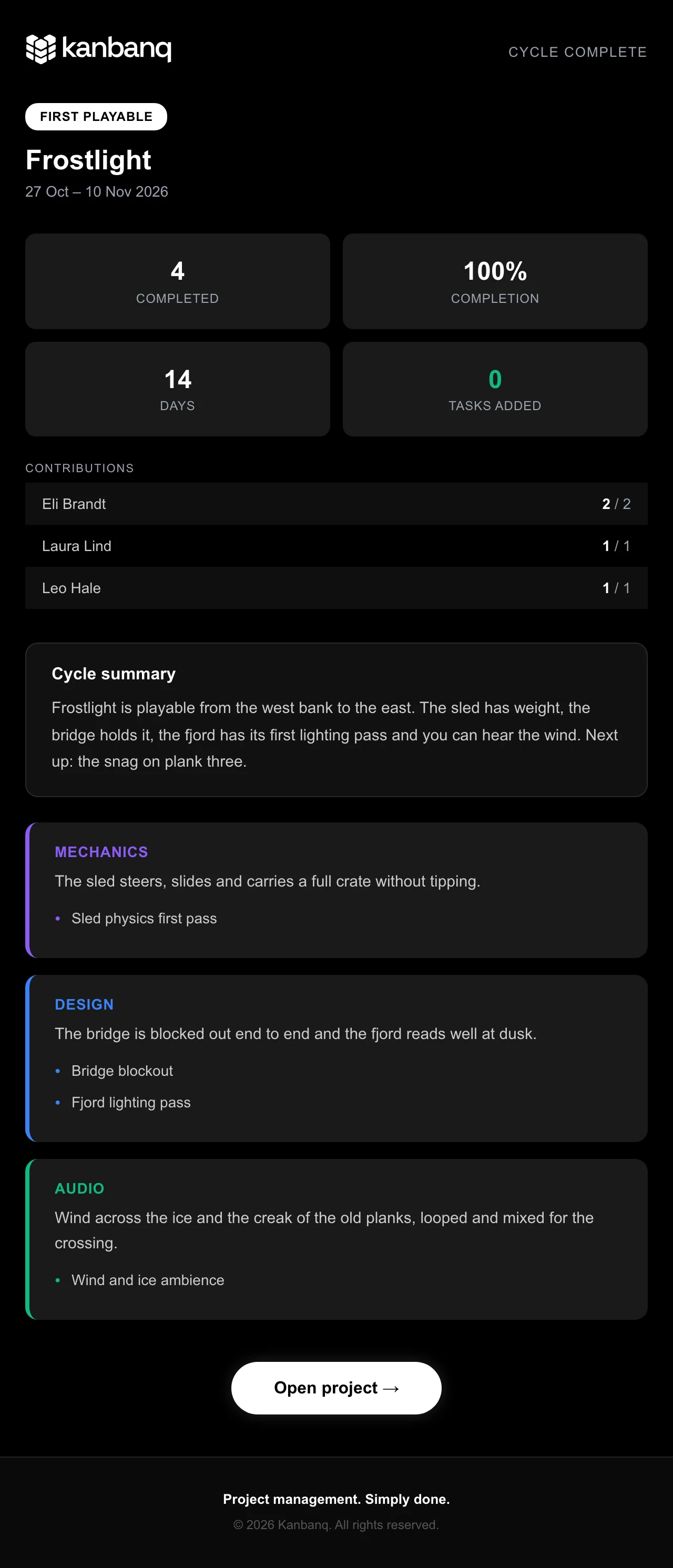
How the summary is written
- 1
It reads what reached Done
Each finished task's title, the text, bullets and checklist on it, and its category. Not the board's conversation, and not what is inside attached files.
- 2
It writes two things
A few lines on the cycle as a whole, then a short write-up for each category, so the art, the code and the sound each get their own paragraph.
- 3
It goes to everyone on the board
One email to each person on the project. Months later, the closed cycles are still there to scroll back through.
It writes from the cards, so a cycle of cards titled only "fix" may get the counts and no summary.
Nothing to write by hand
1
email to everyone on the board, the moment you close it
0
meetings or notes to put it together
Who reads it
A team across time zones
The update is in everyone's inbox when they wake up, with no call to schedule.
Clients and sponsors
Factual and short. Forward it after a phase, or lift the lines you need.
The team, months later
Name each cycle for what it was for, and the history reads like a changelog.
Whoever writes the post
A fair first draft of the devlog, the release notes or the post-mortem.
Nobody writes the update. Everybody reads it.
Questions about AI cycle summaries
What it is
What is an AI sprint summary?
A written report of what a team finished in a sprint. In Kanbanq a sprint is a cycle: when you close one, Kanbanq writes a summary of the cycle and of each category, and emails it to everyone on the board.
What is a cycle in Kanbanq?
A batch of work you finish together. Add tasks, work through them and close the cycle when they are done, with no enforced dates. You name it, whether your team ships weekly or monthly.
Does everyone get the email on every plan?
Yes. The email with the cycle's counts and who finished what goes to everyone on the board, on every plan. What else each plan includes is on the pricing page.
How is a cycle summary different from a retrospective?
A retrospective is a meeting. A summary is written the moment you close a cycle, with no meeting and no write-up. It says what shipped; whether to talk about why is up to you.
How it works
What does the summary's writer see?
Each finished task's title, the text, bullets and checklist on it, and its category. Not the board's conversation, and not what is inside attached files.
Does the summary work for teams that do not make software?
Yes. It covers whatever reached Done, whatever the work: agencies, studios, creators, student groups and freelancers all close cycles too.