Article · Sprints vs cycles
Why we replaced sprints with cycles
Updated
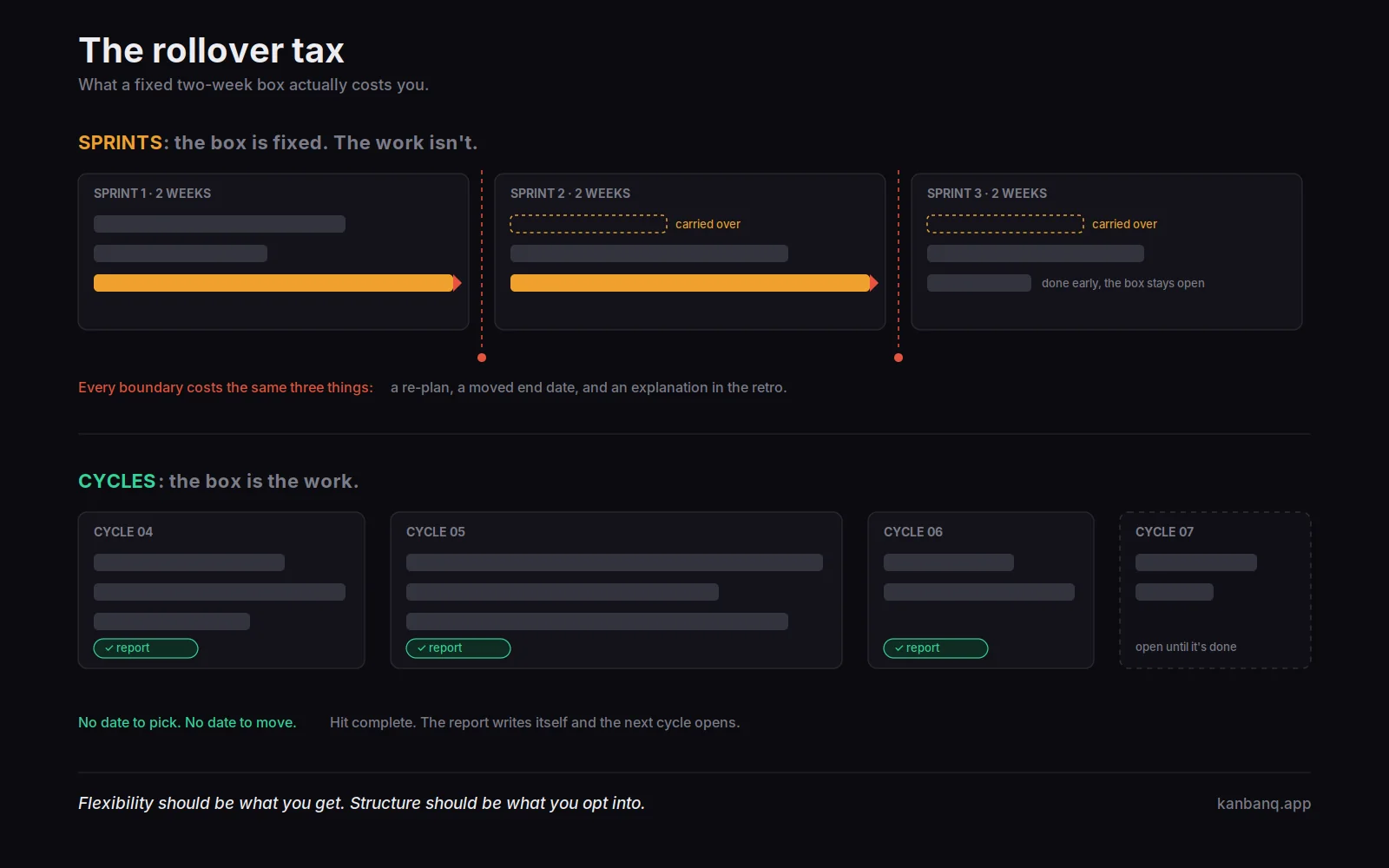
I'd go on holiday. Nobody would close the sprint while I was away, nobody would open the next one, and I'd come back to a week of archaeology, going back in time to repair a sprint that should have rolled over days ago. That happened more than once.
The worse version will be familiar to anyone who has run Linear. The work was finished. It just never got dragged into Done before the automatic rollover ran, so it carried into the next sprint, where it now counts as next sprint's work. It was done. The record said otherwise, and correcting that after the fact is painful.
In neither case was there anything wrong with the work. The sprint demanded attention on a particular date whether or not anyone was around, and when nobody was, it produced a report that was wrong.
Which is a strange thing for a project tool to do, given what it's meant to be for.
How we ended up there
Agile's first principle is that teams should find the way of working that suits them. Then every tool built on top of it hands you a two-week box and tells you to fit inside it. We built that box too. Kanbanq started with sprints: fixed length, start date, end date, everything tied to the calendar. It's what you do. It's what Jira does.
Two months ago we announced replacing them with cycles and filed it under “removing agile jargon”, as though it were a rename. That undersold it, and I want to correct the record, because the thing underneath changed as well.
The box wasn't organising the work. We were organising the box.
What we did
We replaced sprints with cycles. You work, and when the batch is done you hit complete. Kanbanq closes that cycle, writes up what shipped, emails the team the report, and opens the next one. You never set an end date. You never move an end date. Nothing rolls over on a schedule, because there is no schedule for it to roll over on.
The dates don't disappear, before anyone asks. Kanbanq still records when a cycle ran and how long it took. They just come out of the cycle instead of going into it. Nothing is measured against them and nothing breaks when they move.
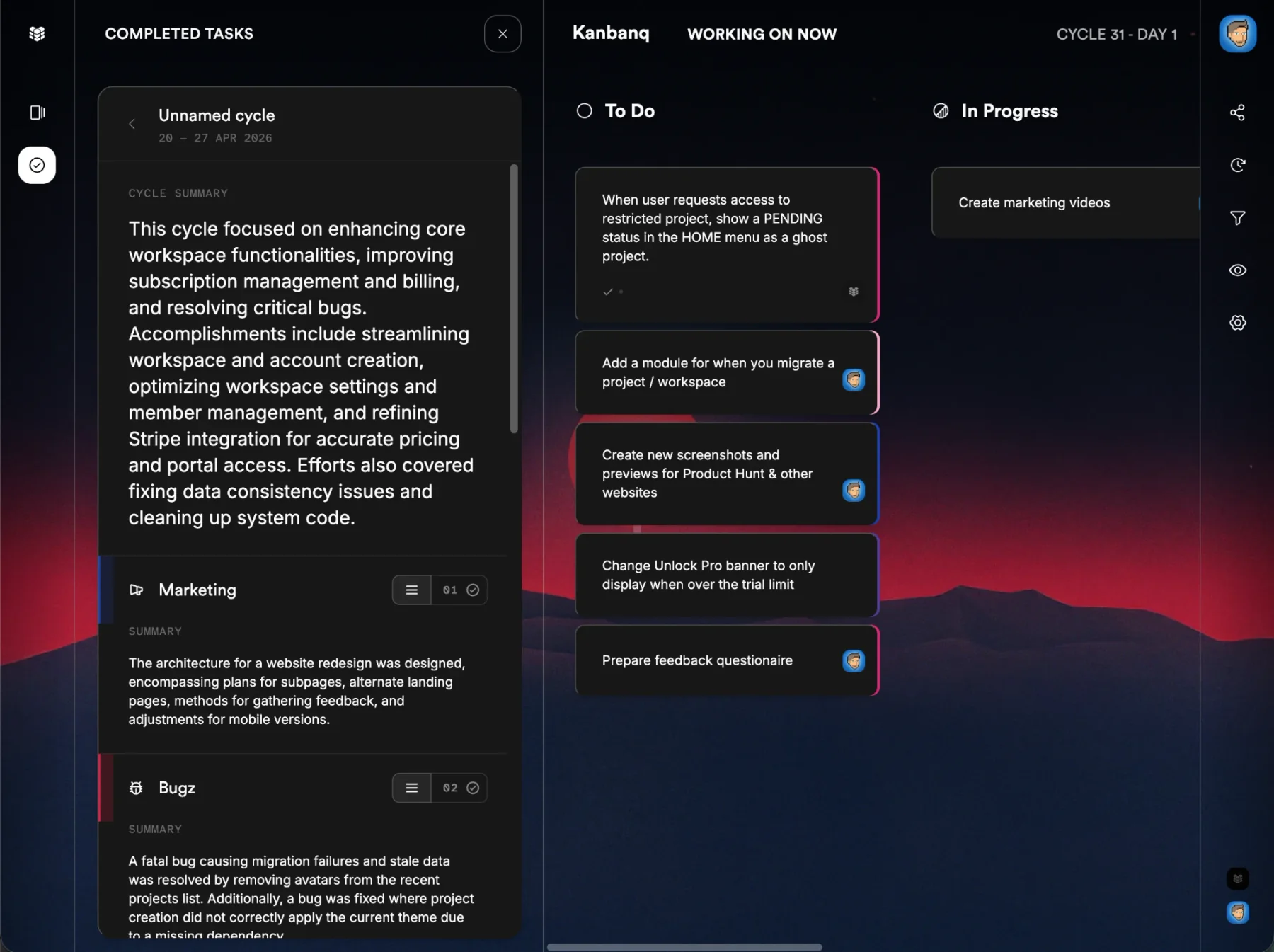
Two things came back from that. The first is an accurate record. When a cycle closes you get a report of what actually got done, and it's accurate because the cycle closed at the moment the work did. It carries the shape of the work as well: you can look back and see that cycle 05 ran three weeks because everyone was buried in one feature. That report is the only thing anyone ever really wanted out of a sprint review.
The second is that nobody has to be present. No planning session to agree dates, no retro spent explaining why the dates slipped, nothing sitting broken because one person is away. The dead Monday at the start of a sprint and the Friday scramble both went with it, and the motivation sprints are supposed to manufacture, always shipping something, survives fine without the calendar.
The honest part, because someone is about to say it
Timeboxes are not stupid. A fixed box creates pressure, and pressure creates scope discipline. It gives you a velocity number. It lets you tell someone outside the team when a thing will land. Take the box away and on some teams the work will simply expand to fill the space.
That trade is fine for three people shipping to themselves. It is not fine for a twelve-person team with a stakeholder waiting on a date. We know that. We'll probably add optional lengths back, so a cycle can be timeboxed if you want one.
Optional, though. Not the default. That's the actual position. Every other tool has it the other way round.
Flexibility should be what you get. Structure should be what you opt into.
Kanbanq is free, for any number of people, with up to 3 boards and 250 active tasks. Two of us build it. Our own board is public if you want to see it running: the Kanbanq team's board.
I'm interested in the pushback, particularly from anyone running timeboxes on a larger team. Where does this fall over?