Compare · Codecks
A Codecks alternative for game teams
Updated
Why game teams pick Kanbanq
Codecks is made for game teams too, with a card game's words for everything: Decks, the Hand, Hero Cards. Its free plan stops at five people. Kanbanq keeps to plain words and lets the whole team in.
The whole team, free
Free has no limit on people, so the artists, the writer and the composer all join, and everyone's cursor shows on the board as they work.

Plain words: the board and later
The work under way sits on the board. Everything that can wait sits in Tasks for later, sorted by category.

Close a cycle, get the email
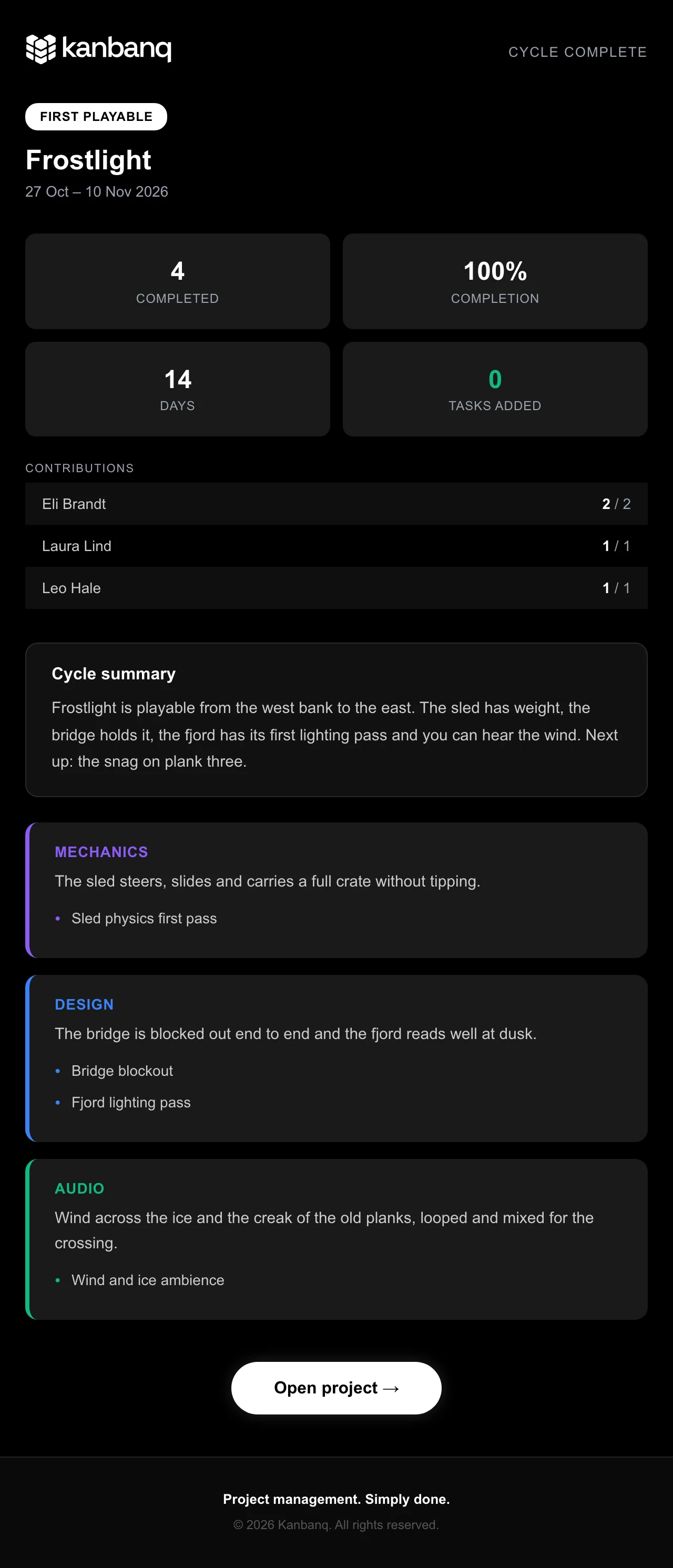
Close a cycle when the work is done. Done is archived and the whole team gets an email of what shipped, with a written summary.
Hear the sound on the card
A sound plays, a clip runs and a 3D model turns right on the card, and Markdown, code and tables read as pages.

Your coding agents, on your board
Claude Code, Cursor and others connect through Kanbanq's own MCP server: read on every plan, write on Pro. Paid plans add agents to the team at no charge.

One price for the whole team
Codecks is free for five people, then charges for every seat. Every Kanbanq plan is one price for the whole team, and Free has no limit on people at all.
A team of 20, billed yearly
Kanbanq
€490
a year on Team, for the whole team of up to 30.
Codecks
€1,440
a year on Plus, at €6 a seat a month for 20 seats.
Every Kanbanq plan
No limit on people on Free
Free is free for any number of people, with no time limit.
One price for the team
Pro covers up to 10 people, Team up to 30 and Studio any number. Nobody counts seats.
Agents at no charge
Every paid plan can add as many agents as it likes, with no charge for each.
A public board, on Free too
A read-only board anyone can open with its address, to build in public.
Billed yearly, by team size
| Team | Kanbanq | Codecks Plus |
|---|---|---|
| 10 people | €90 (Pro) | €720 |
| 20 people | €490 (Team) | €1,440 |
| 30 people | €490 (Team) | €2,160 |
| 40 people | €2,000 (Studio) | €2,880 |
Both billed yearly, as each pricing page lists them; Codecks' page shows no monthly prices. Month to month, Kanbanq is €9 for Pro, €49 for Team and €200 for Studio. The plans hold different things: this is what each charges, not what each includes.
Side by side
Codecks is made by game developers for game teams, and covers more of production. Here is how the two compare, Kanbanq first.
| What | Kanbanq | Codecks |
|---|---|---|
| People on Free | Any number, with no time limit. 250 active tasks and 10 attached files of up to 5 MB, on up to 3 boards. | 5 users and 3 projects, with 1 GB of storage and files up to 10 MB. |
| The words | Plain ones: tasks on a board, Tasks for later, and cycles. | A card system of its own: Cards, Decks, the Hand and Hero Cards. |
| Cycles | Cycles, closed when the work is done. Closing one archives Done, keeps its numbers and emails the team a written summary. | Milestones and Runs. |
| Coding agents | Kanbanq's own MCP server, for Claude Code, Cursor and others: read on every plan, write on Pro. Paid plans add agents to the team at no charge. | The MCP server listed for it is built by its community, not by Codecks. |
Where Codecks does more
| What | Kanbanq | Codecks |
|---|---|---|
| Dates, dependencies and hours | No due dates, dependencies or time tracking today. Due dates and milestones are coming soon. | Due dates, with Beast Mode to escalate overdue cards, cards that wait on other cards, and time tracking. |
| Players and playtesters | No Discord integration or in-game bug reports today. | A Discord bot that turns feedback into cards, and bug reports from inside Unity, Unreal or Godot. |
| Public roadmap | A read-only board; visitors cannot vote or comment today. | Open Decks: a public roadmap fans can upvote, with email updates. |
Codecks' prices and plans are from its pricing page, read on 22 November 2026, and its other facts from its own website, read on 2 October 2026. Kanbanq's are from the product.
Which one to pick
Both lists are meant to be used. If Codecks' describes your team, stay where you are.
Pick Kanbanq if
- There are more than five of you, and nobody should pay to join.
- You want the write-up done and emailed when a cycle closes.
- Your team passes sounds, clips and models around and wants them to open on the card.
- Your coding agents should read the board, and on Pro update it.
Pick Codecks if
- You plan against due dates and want overdue cards to escalate.
- Some tasks cannot start until others finish, or you log hours.
- Players send feedback through Discord, or playtesters report bugs from inside the build.
- You publish a roadmap and want fans to upvote it.
If your team plans around due dates, dependencies, logged hours or player feedback, Codecks is the better tool for you today. Due dates and milestones are coming to Kanbanq soon.
Moving over from Codecks
Kanbanq has no importer, so a move makes a new board from the work that is still open. Bring the next cycle or two, not the archive.
- 1
Start a board
Sign up, make a project and give the board a background. It arrives with To Do, In Progress and Done, and its first cycle open.
It is free, and so is everyone you invite. Free holds 250 active tasks and 10 attached files. Pro has no limit on either.
- 2
Bring the open cards across
Make a card for each open Codecks card, on the board for now or in Tasks for later. A Deck can become a category, and a card's text and checklist copy across as you go.
Files stay in Codecks. Add back the ones that matter: models, sounds and documents open right on the card.
- 3
Bring the team in
Invite everyone, then give each card its person. You see their cursors as they arrive, and the project feed takes @mentions and #card links.
- 4
See one cycle through
Name the first cycle, and complete it when the work is done. Keep Codecks open until then. If you keep reaching for a due date or a timer, that is your answer, and a fair one.
What stays behind. Card comments, player votes and the feedback gathered on Discord stay in Codecks. Nothing stays in step with it afterwards.